The Dark Continent
Megan Jenkinson
June 8 - July 8 2007


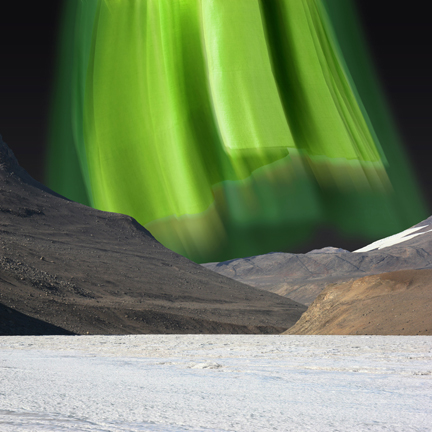 |
| Atmospheric Optics I |
In October 2005, Megan Jenkinson visited Antarctica as an Arts Fellow courtesy of Antarctica New Zealand and with the support of Creative New Zealand. "The Dark Continent", exhibited at Jonathan Smart Gallery in June 2007, is inspired by that visit. We are presented with the fruits of a lyrical imagination treated to a long and rigorous journey.
In the Atmospheric Optics series, Jenkinson creates aurora above the frozen landscapes. Details of billowing fabric in rich greens, reds and oranges are scanned into digitally blacked out skies - the landscapes below remaining pristine in the clarity of daylight. The effect is operatic and sumptuous. Details of fabric from sources as varied as the Victoria & Albert Museum, and Versailles, float blurred and baffle-like above glacial cliffs, mountains and sea ice. And their format, an unusual 900mm square, place the images quite appropriately I think between both culture and nature. Or between the vertical and horizontal, if you like.
 |
|
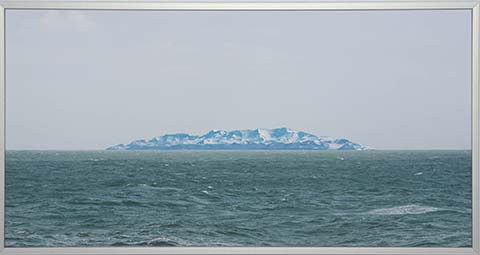
Certain Islands - Trulskippen (view 1)
|
 |
|
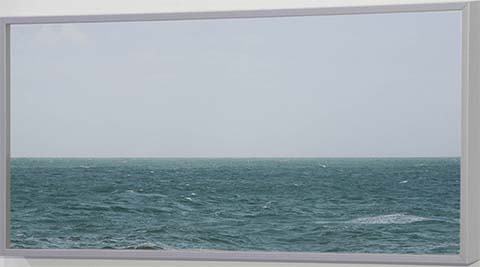
Certain Islands - Trulskippen (view 2)
|
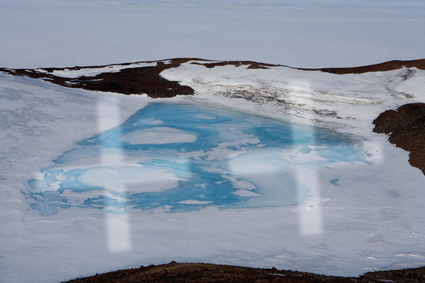 |
| Occlusion II - Crater Lake |
In the Certain Islands works, Jenkinson explores another atmospheric phenomenon of the deep south - the mirage. Southseas explorers discovered, named and plotted on charts, fifteen islands that were in fact mirages - they did not exist. Jenkinson's choice of the lenticular process to describe these flickering and ephemeral landscape presences is perfect. She presents fragments of Antarctica - mountain ranges, peaks such as Erebus, and bare rock outcrops, scanned into seascapes. (For there was no melt of the sea ice near Scott Base in October, 2005.) This digital image is then laminated on to very finely ridged plastic, so that from front on everything is present, but with any change of viewing angle the islands disappear. The two views of Trulskippen are a case in point - a wonderful merging of technique, process and subject matter.
And finally, a word about the crosses viewfinder-like in the landscapes of the Occlusion series I - III. They refer to slits, one horizontal one vertical, that polar explorers like Scott cut into their visors to reduce snowblindness. Light beautiful, yet so brutal. The Polar Night works continue this theme. The intimacy of their detail is still, dry, crystalline and geomorphic. Yet their sense of scale is vast. Such is the nature of beauty interrogated at the bottom of the world.
Jonathan Smart
Selected works

Atmospheric Optics II

Atmospheric Optics III

Atmospheric Optics IV - Wilson's Prayer

Occlusion I - Polar Plateau

Occlusion III

Polar Night 1

Polar Night II

Polar Night III

The Instrument of ice
Details of works
Polar Night I - II, Occlusion I - Polar Platea: Digital prints on watercolour paper (500mm x 690mm, framed). Edition of 5
Atmospheric Optics I - IV: Digitals print on Hanhamule paper (930mm x 930mm, framed). Edition of 5
The Instrument of Ice: Digital print on watercolour paper (2800 x 432mm). One of edition of 5, unframed